

Facts & Myths
Singer Featherweight Facts
and Some Myths Exposed
by Graham Forsdyke
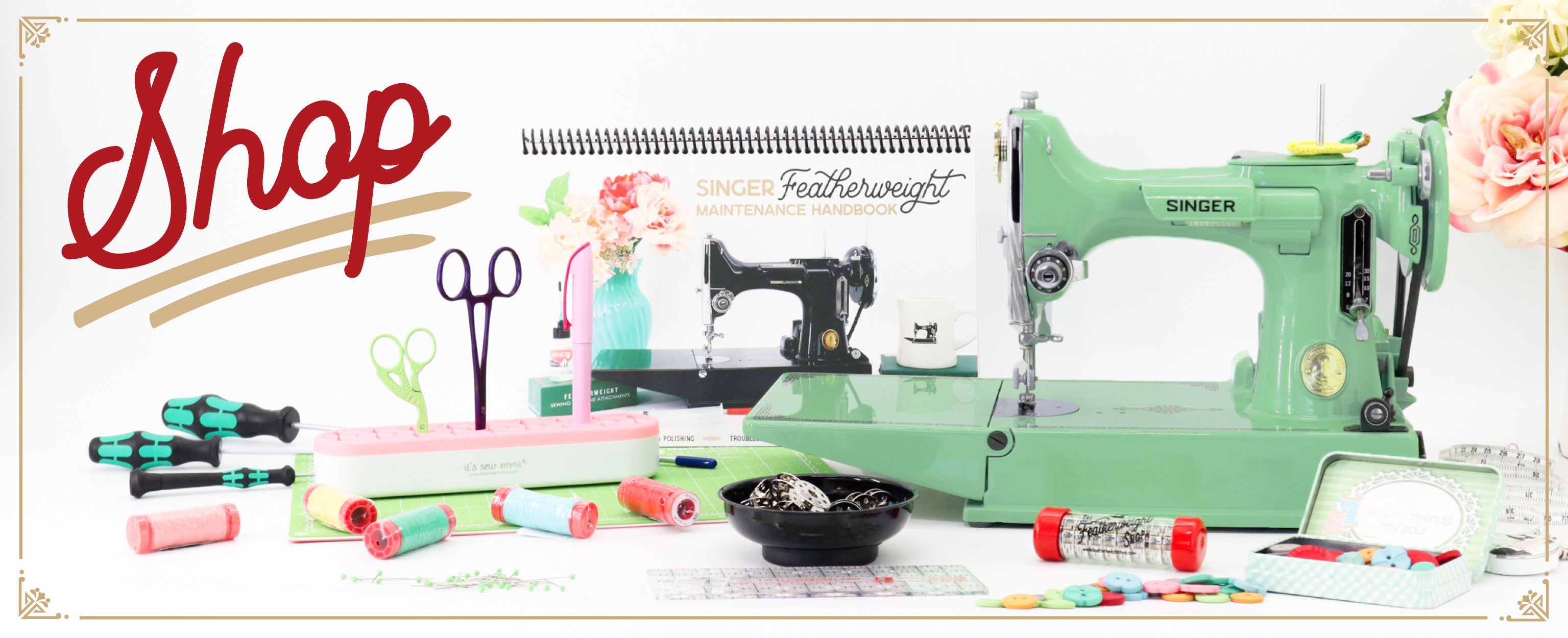
- Singer Featherweight machines were produced in black, beige/tan and white/green (what the company officially called Pale Turquoise).
- There were no red, blue or any other colour machines although many have been repainted in later life and new decals added.
- Black 221 machines were produced at Elizabethport, New Jersey, and at Clydebank, Scotland.
- Beige/tan machines were produced at Clydebank and at St John's, Canada.
- White/Green machines were produced only at Clydebank.
- 222 Freearm Featherweights were produced only at Clydebank.
- Many UK-built machines were sent across the Atlantic to have motors fitted in Canada for the North American market.
- There was no difference in build quality between either of the factories. Both used identical tools for manufacture and raw material specifications were the same.
- The fabric/rubber belt on White/Green machines does not break. In fact, it makes for a quieter and slightly-lighter machine.
(We have found that many deteriorate with age from not being used, so if yours is in good condition, use it!) - Myth: "Repairmen did not like the White/ Green machine and spread rumours about its unreliability." This is not true. The reason it was not favoured in the trade was because of the internal belt, which meant that the whole machine could not be dumped in cleaning fluid as a quick and easy service option.
- Far more than 9000 Freearm machines were made –– probably ten times that number but still the rarest variety.
- The 222 Freearm was not marketed in the USA. American Singer bosses thought it would be too expensive to have a ready market. It was sold in Canada, England, Australia and much of Europe.
- The Standard 221 black Featherweight was for many years Singer's top-selling model.
- Featherweight tables and cabinets were not marketed outside of North America.
- It is not possible to accurately state the manufacturing date of any Singer Featherweight. Singer claims to be able to do this, but the information the company gives out refers to the dates on which large batches of serial numbers were released to the various factories. It's pretty safe to assume that a particular machine was not made before its "birthdate" but it could have been produced considerably later. (click here for more details)
- It is impossible to state the exact date on which minor specification changes took place – for example the switch from "deco" face plate to the striated design. Parts bins at the factory were topped up as they became low and it was quite possible for an early feature to appear on a later machine as the parts bin got lower again. You can verify with old parts and shop manuals, however, as to what year some of these changes took place.
- The appearance of "striated" face plates on earlier machines can be explained in two ways.
1) If the lower thread guide was broken off the deco plate on an early machine, the plate would be replaced by the serviceman with the only available spare – the newer striated plate.
2) Dealers would often "up-date" early machines they had taken in trade, or which had remained unsold, with the latest cosmetic parts to aid sales. - The 222 embroidery hoop was never a part of the standard package – it was available as a separate add-on.
- The accessory package which came with each new machine varied through the years