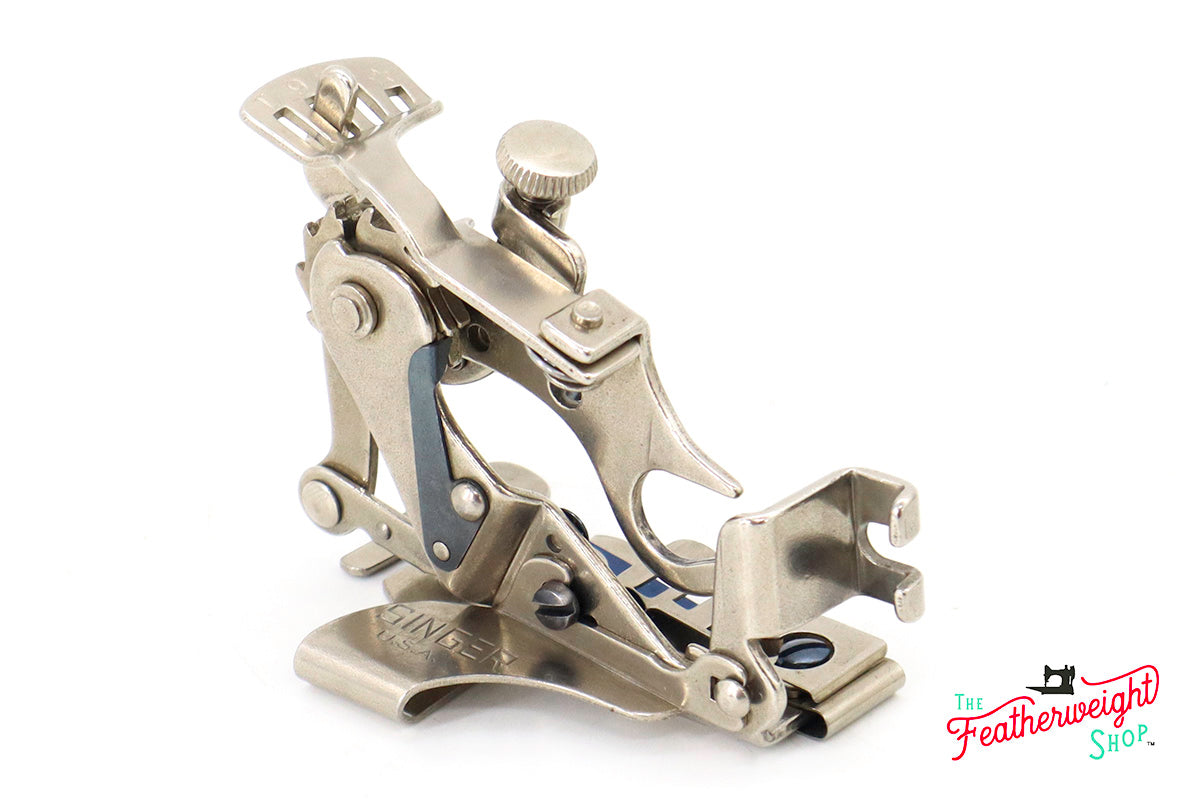
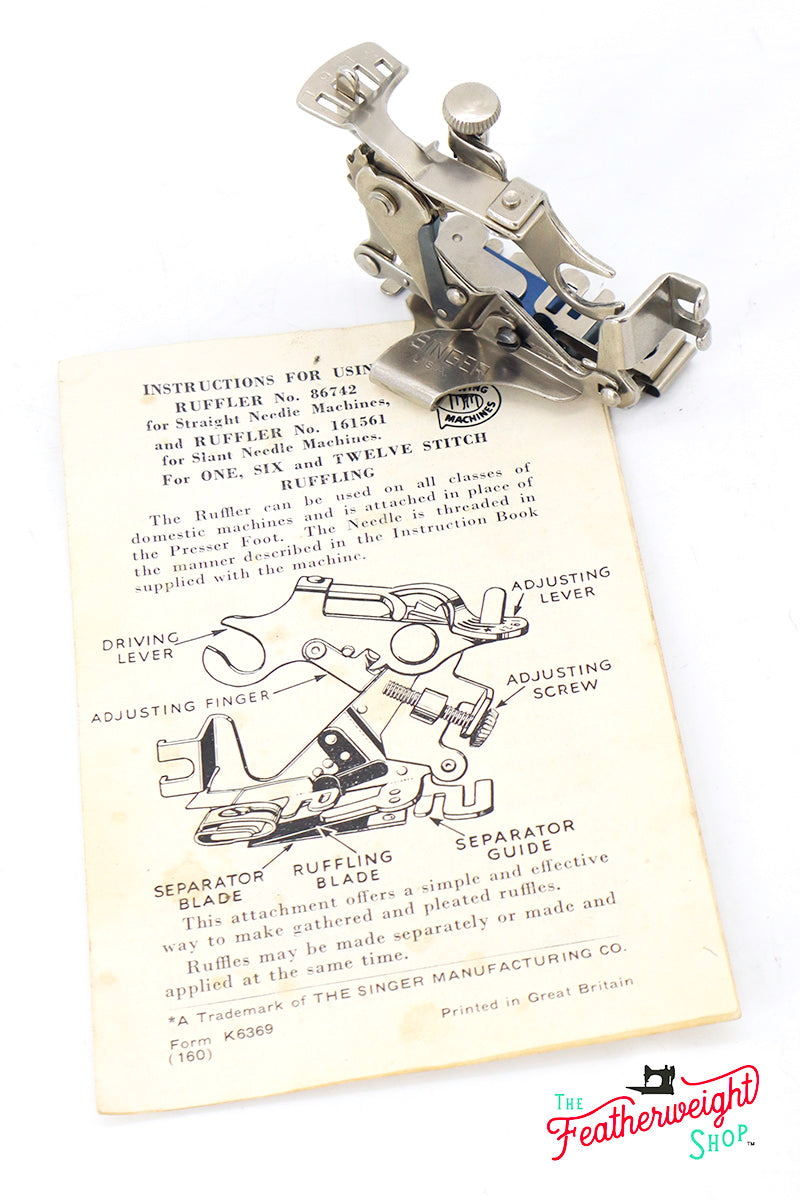
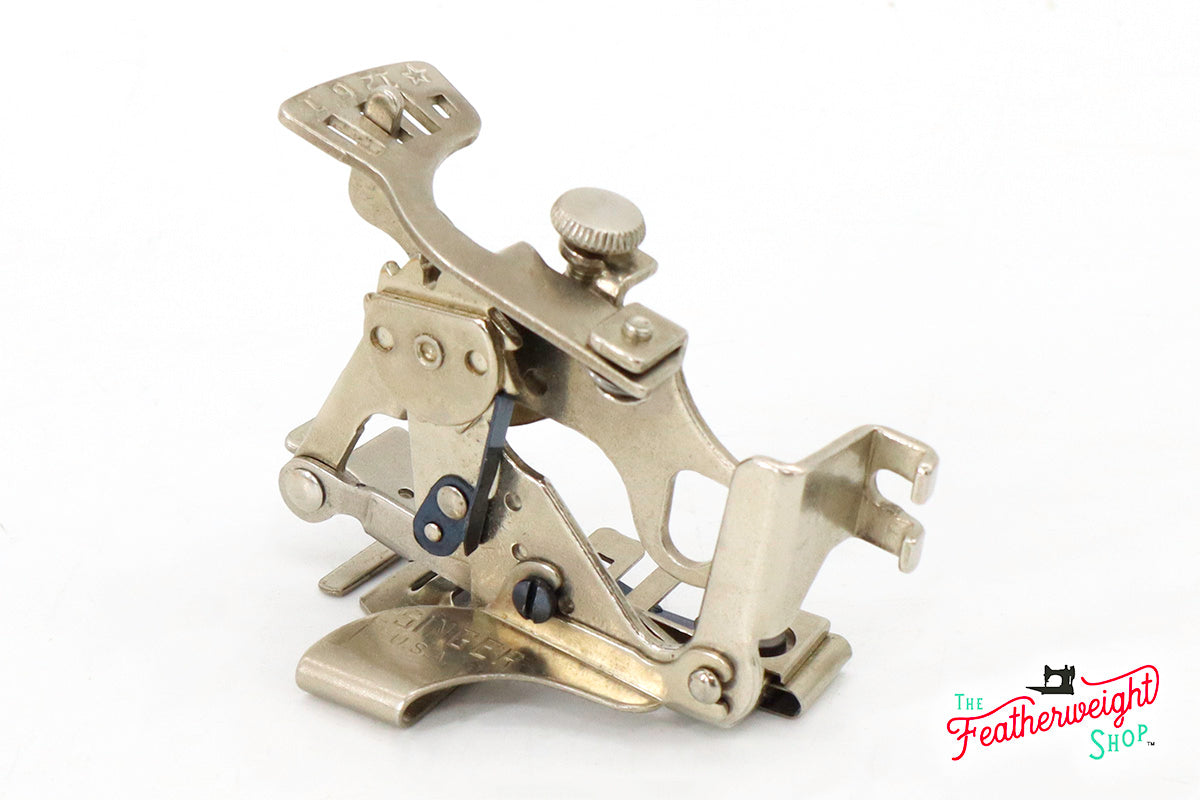
Lines 1, 2, 3, 4, and 5 in Fig. 42 indicate where the material is to be placed for various operations, as follows:

Line
1 -- the correct position for the material to which the ruffled material is
applied. Line 2 -- material to be ruffled. Line 3 -- the facing for the ruffle.
Line 4 -- the strip of piping material. Line 5 -- the edge to be piped. Refer
to Fig. 42 when inserting the material in the ruffler
that the projection (D) will enter the slot marked "1" in the adjusting lever (E) when the lever is released. The ruffling blade will then move forward and back once at every stitch. Insert the material to be ruffled between the two blue blades, following the line 2 in Fig. 42. Draw the material slightly back of the needle, lower the presser bar and commence to sew.

To make fine gathering, shorten the stroke of the ruffling blade by turning the adjusting screw (C) upward; also shorten the stitch. To make full gathering, lengthen the stroke of the ruffling blade by turning the adjusting screw (C) downward; also lengthen the stitch. By varying these adjustments, many pleasing varieties of work can be accomplished
J -- SEPARATOR BLADE -- the lower blue steel blade without teeth, which prevents the teeth of the ruffling blade coming into contact with the feed of the machine or the material to which ruffle or plaiting is to be applied.

To Attach the Ruffler to the machine
Raise the needle bar to its highest position and remove the presser foot.
Attach the ruffler foot (A) to the presser bar from the right and fasten by
means of the thumb screw, at the same time placing the fork arm (B) astride
the needle clamp as shown in Fig. 43.
To Adjust the Ruffler for Gathering
The adjusting finger (F) is not intended for gathering and should be moved
forward and away from the needle, as shown in Fig. 43.
Raise the adjusting lever (E) and move it to the left so
To Make a Ruffle and Sewon a facing in One
Operation
Insert the material to be ruffled between the two blue blades, following the
line 2 (Fig. 42).

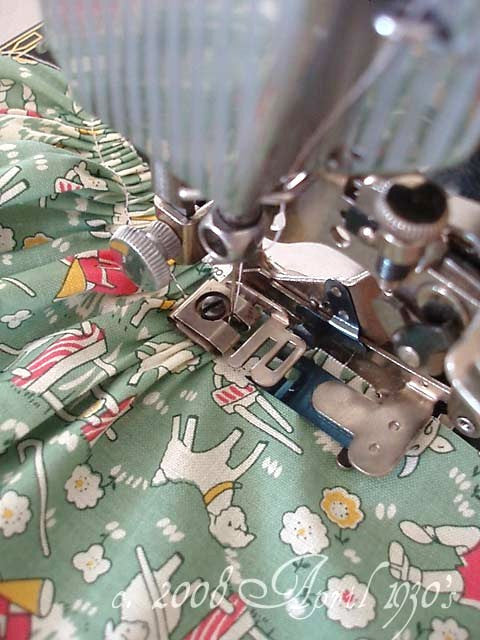
Place the garment to which the ruffle is to be attached under the separator blade, following the line 1 (Fig. 42). Place the material for thefacing over the upper blue blade, as shown
in Fig. 45, following the line 3 (Fig. 42). The facing may be straight or bias material. If thefacing is to be on the right side of the garment, place the garment and the ruffle so that the wrong sides are together. If the facing is to be on the wrong side, place the right sides of the garment and the ruffle together.

Piping a Ruffle
Insert the material to be ruffled between the two blue blades, following the
line (Fig. 42). This material must not be over 1 1/4 inches wide, as it is
carried through the ruffler with the finished edge of the ruffle to the right
of the attachment as shown in Fig. 46. The material for piping must measure
about 1/4 inch wide when folded in the centre and is usually cut on the bias.
Place the piping material in the ruffler, following the line 4 (Fig. 42) with
the folded edge of the piping to the right. The
material to which the piping and ruffling are to be sewn should
be folded on the edge and inserted in the ruffler, following the line 5 (Fig.4)
To Adjust the Ruffler for Plaiting
Raise the adjusting lever (E) and move it to the right so that the projection
(D) will enter the slot marked "6" in the adjusting lever when the lever is
released. The ruffling blade will then move forward and back once at every
six stitches. To adjust the ruffling blade to make a plait once at every twelve
inches, place the adjusting lever (E) so that the projection (D) enters the
slot marked "12" in the adjusting lever. Insert the material to be plaited
between the two blue blades, following the line 2 (Fig. 42). The size or width
of plaits is regulated by the adjusting screw (C) and the adjusting finger
(F, Fig. 47). To make a wider plait, move the adjusting finger (F) back or
toward the needle and turn the adjusting screw (C) downward. To make a smaller
plait, turn the adjusting screw (C) upward. The distance between plaits is
regulated by the length of stitch.
To Adjust the Ruffler for Group Plaiting and Gathering
The ruffler can be adjusted for group plaiting by lifting the adjusting lever
(E) and moving it to the right so that the top of the projection (D) enters
History, dating, manuals, parts lists etc
Featherweight History Machine Dating Condition Chart Accessories Parts lists/numbers Owners' Manuals Workshop Manuals Featherweight Facts and Myths Freearm Applications Advertising Art Work Cleaning Your Machine - Chamber of Horrors Identify Your Manual Approved Links
![]()
For the best selection of the finest
available
Featherweights
Standard
Machines 1951
Centennials White/Green
Models Freearm
222s Singer Featherweight
Toys Spare Parts
Sales Accessory
Sales Our Guarantee
Repairs/Servicing
Motor rebuilds and voltage
conversions What
our customers say
Lay-away plan
Fig
44
Fig
45