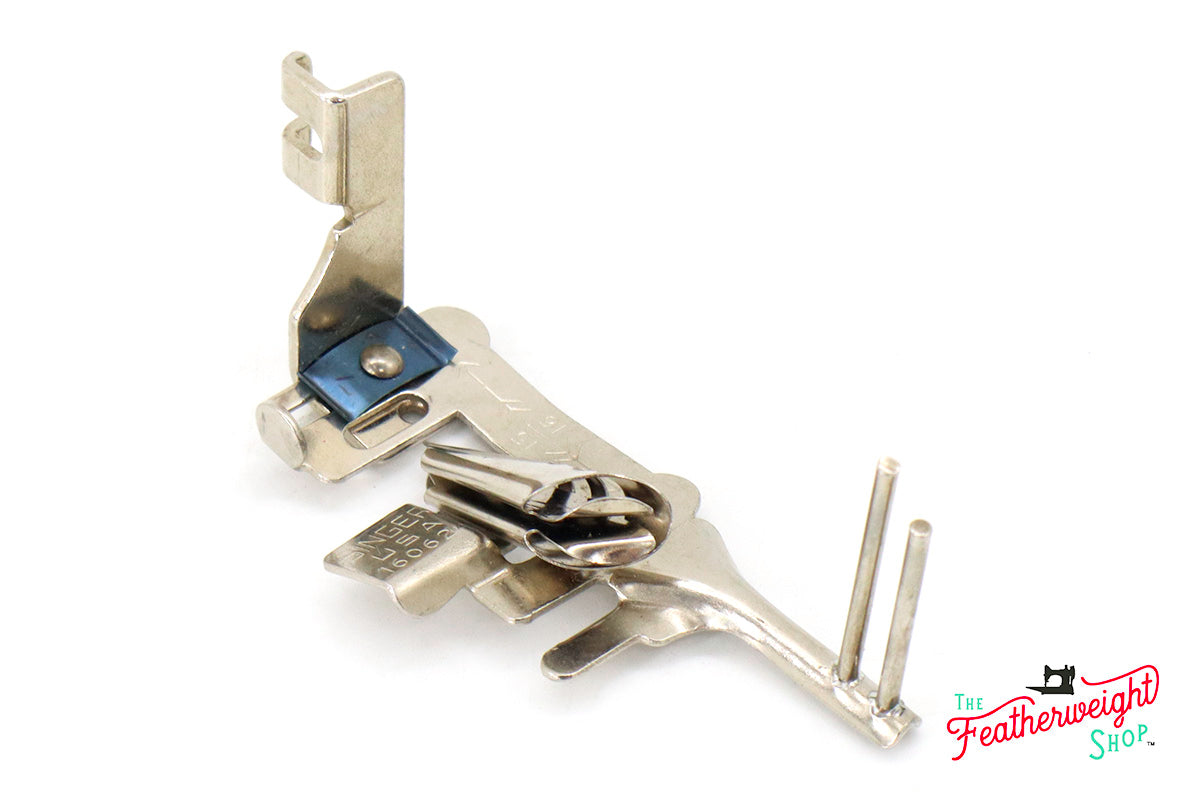
Featherweight Accessory
Instructions: The Multi-slotted Binder
As two different widths of binding of contrasting
colours can be fed through the Binder at the same time, attractive bindings
and piping effects can be produced in one operation.
To attach the Binder
Raise the needle to its highest position, then attach the Binder to the presser
bar in place of the presser foot. See that the needle enters the centre of
the needle hole.
To
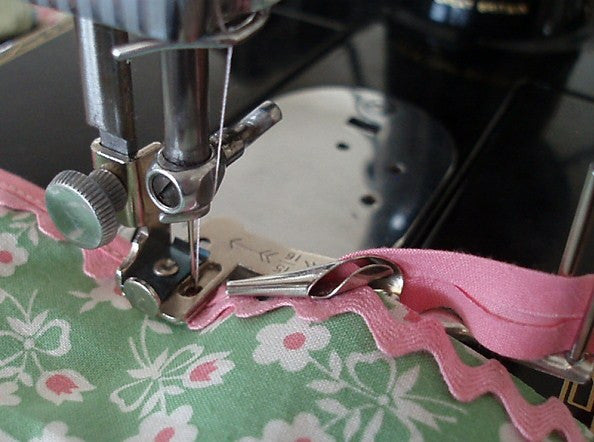
Insert the Garment in the Binder
Place the edge to be bound as far to the right as it will go in the centre slot
of the scroll, as shown in Fig. 37, and draw it back under the binder foot.
Lower the Binder by means of the presser foot lifter, and commence
to sew. Keep the material well within the centre slot of the scroll so that
the edge will be caught in the binding.
To Adjust the Binder
To bring the inner edge of the binding closer to the stitching, move the scroll
(C2, Fig. 37) to the right by means of the lug (B2, Fig. 37). This is the usual
adjustment when binding straight edges. When binding curves move the scroll
to the left to bring the inner edge of the binding further from the stitching
and allow for the sweep of the curve.
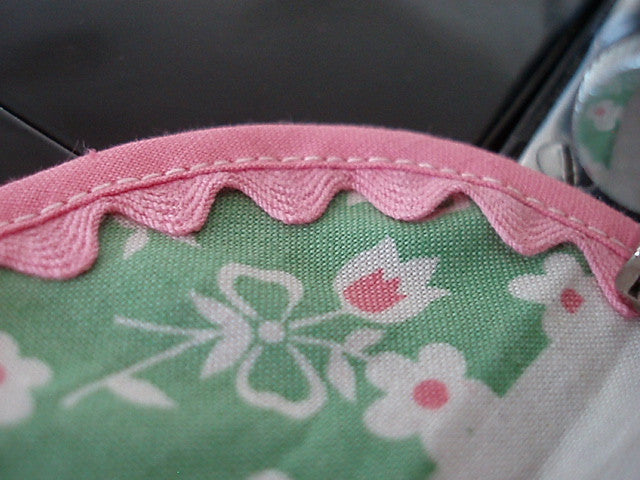
Piped Edge
To produced a piped edge on garments, move the lug (B2, Fig.
38) to the left to bring the stitching about midway of the folded binding.
Crease the raw edges of the garment toward
the wrong side about 1/8 inch, and insert the folded edge, raw edges uppermost,
into the edge guide on the Binder and beneath the binding.
When stitched, both sides of the garment will
be finished, and the right side will show the piped edge.
Piping
and Binding in One Operation
A garment can be piped and bound in one operation, as shown in Fig. 39.
IMPORTANT:
When piping and binding at the same time, as shown above, insert the narrow
width of binding first, in its slot, then insert the wider width in its slot.
Two consecutive widths should not be used at the same time. That is, if No.
1 is used, the wider binding should not be smaller than No. 3. If No. 2 is used,
the wider binding should be not less than No. 4. Never use Nos. 1 and 2 or 2
and 3, etc, together. Use the upright guide pins to guide the wider of the two
widths of binding, as shown in Fig. 39.
To
Bind Outside Curves allow the edge to be bound to pass freely through the
scroll without crowding against the scroll wall. The material must be guided
from the lack of the Binder and to the left, permitting unfinished edges to
swing naturally into the scroll of the Binder.
Never pull the binding while it is being fed through the Binder, as this may
stretch the binding, making it too narrow to stitch or to turn in the edges.
When binding curves, turn the material only as fast as the machine sews Do not
push the material in too fast as this will pucker the edge. Do not stretch the
material as this will distort the edge so that the curve will have the proper
shape when finished. If the stitching does not catch the edge of the binding,
adjust the scroll slightly to the left.
To Bind inside Curves When binding an inside curve, straighten out the
edges of the
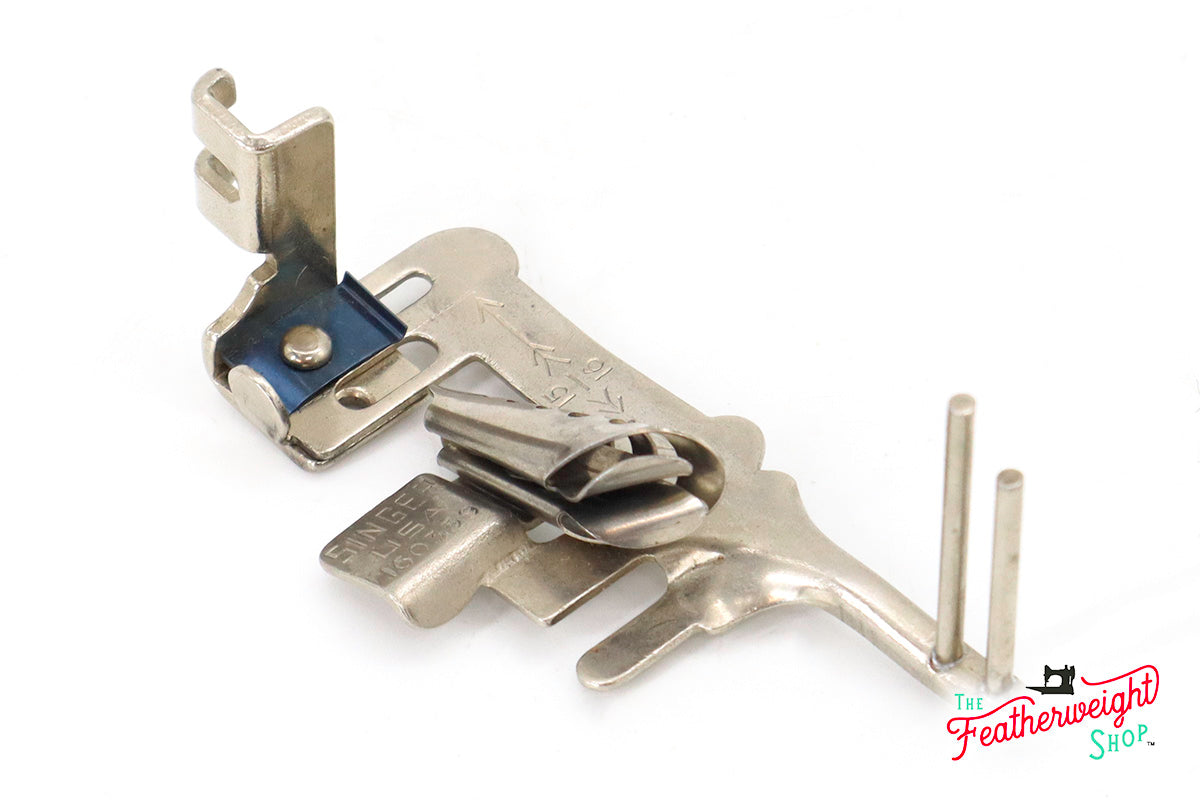
This
multiple slotted binder will apply unfolded bias binding 15/16 inch in width
and commercial folded binding in sizes 1, 2, 3, 4 and 5 to the seams or to the
edges of garments. These sizes of folded binding are 1/4, 5/16, 7/16 and 1/2
inch in width, respectively, and are fed through slots of corresponding sizes
in the binder scroll. (See Fig. 35). Binding may be purchased in a variety of
materials and colours. For convenience in determining the correct width of unfolded
binding this measurement is marked on the Binder, as shown in Fig. 35. The two
upright guide pins shown in fig. 35 eliminate manual guiding of the binding.
The
wide range of bindings that can be applied with this Binder makes it useful
for a large variety of work. It will be found particularly advantageous for
making children's wear, lingerie, summer dresses, and other dainty articles
which call for the narrower bindings.
To
insert the Binding in the Binder.
Cut all binding to a long point to
the left, as shown in Fig. 36.
Folded Bias Binding must be inserted in the slot or slots of corresponding
sizes. (See Fig. 39).
Unfolded or Raw Edge Bias Binding must be inserted in the open end of
the scroll. (See Fig. 37).
After
inserting the pointed end of the binding in the Binder, push it through until
the full width of the binding is under the needle.
Guide the binding by means of the two upright pins, as shown in figs. 37 and
39.
material
while feeding it into the Binder, being careful not to stretch the material.
Soft materials like batiste or crepe de chine require a row of stitching added
close to the edge of the curve before binding
To Apply French Folds to Curves Place the material under the Binder and
stitch the binding onto the face of the material, as shown in Fig. 41
For
guidance in applying the rows of French folds, mark the material with a line
of basting stitches or with chalk or pencil.
Fig
35
Fig
36
Fig
37
Fig
38
Fig
39
Fig
40
Fig
41